The Period Tax Is Personal: Why Menstrual Product Costs Are a Reproductive Justice Crisis in Disguise
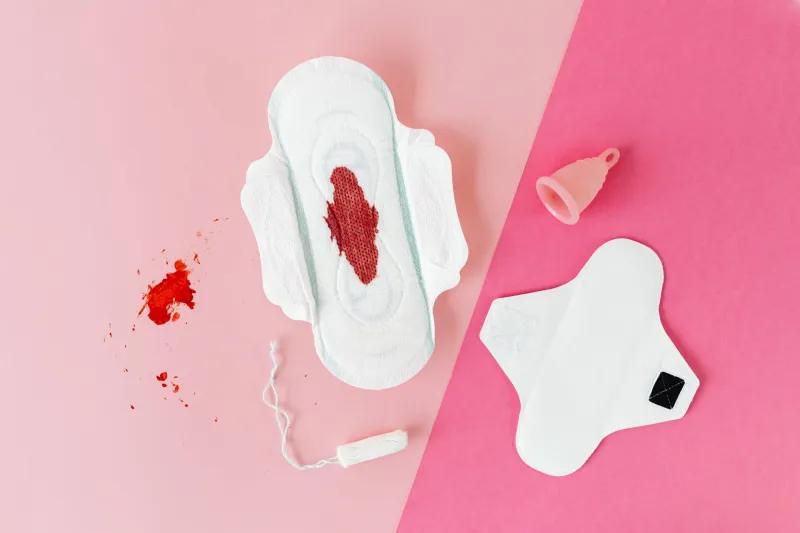
Let's be clear about something upfront: tampons and pads don't prevent pregnancy. Menstrual cups don't regulate hormones. Period underwear won't show up in a contraception formulary. So why does a site called Birth Control Bank care about period products?
Because reproductive health doesn't start and stop at contraception. And because the same systems that make birth control financially inaccessible — regressive tax structures, employer benefit gaps, income-based healthcare tiers — are the exact same systems that treat menstruation as a luxury, a personal problem, or an inconvenient footnote in the healthcare budget. You can't talk about one without the other.
The Lifetime Number Nobody Wants to Say Out Loud
The average person who menstruates will have roughly 450 periods over the course of their reproductive life. Depending on flow, product preference, and cycle length, monthly spending on menstrual products runs anywhere from $10 to $25. Over a lifetime, that's a conservative $5,000 to $15,000 — and that estimate doesn't account for the compounding cost of period-related pain management (ibuprofen, heating pads, missed work), specialty products for conditions like endometriosis or PCOS, or the premium pricing that hits low-income shoppers who can only buy in small quantities.
For someone earning $30,000 a year, a $15 box of tampons isn't trivial. It's a recurring, non-negotiable expense that arrives every single month, whether the budget accommodates it or not. Period poverty — the inability to reliably afford menstrual products — affects an estimated one in five teenagers in the US, and the problem doesn't end at eighteen.
The Sales Tax That Refuses to Die
Twenty states still tax menstrual products as non-essential goods. That means in states like Texas, Georgia, and Alabama, you are paying a sales tax on tampons that you would not pay on, say, a bottle of Rogaine or a box of Viagra. The logic has never held up to scrutiny — menstruation is not optional, and the products that manage it are not discretionary — but the tax persists because the people who set tax policy have historically not been the people who menstruate.
The so-called "tampon tax" generates relatively modest revenue for state governments — estimates suggest it pulls in a few hundred million dollars nationally per year — but the burden falls disproportionately on low-income households. A family already stretching every dollar doesn't have the flexibility to absorb a 6–9% surcharge on a non-negotiable health product. The cumulative cost over years is real, even if each individual transaction looks small.
Twenty-nine states and the District of Columbia have now eliminated or never imposed the tampon tax. Progress is real. But patchy, state-by-state progress means your zip code still determines whether your period is taxed — which is exactly the kind of geographic inequity that shows up across reproductive healthcare.
FSAs and HSAs: A Partial Win That Leaves Most People Out
The CARES Act of 2020 did something genuinely useful: it made menstrual products eligible for purchase with FSA (Flexible Spending Account) and HSA (Health Savings Account) funds. If you have one of those accounts, you can now buy tampons, pads, menstrual cups, and period underwear tax-free, using pre-tax dollars.
That's good. It's also deeply limited.
FSAs and HSAs are employer-sponsored benefits, which means you have to have an employer who offers them. According to the Bureau of Labor Statistics, only about 36% of private-sector workers have access to an FSA. The workers least likely to have access? Part-time employees, gig workers, service industry workers, and lower-wage employees — the exact populations most likely to be experiencing period poverty in the first place.
The tax benefit also only works if you have money to put into the account upfront. FSAs are use-it-or-lose-it by design, and contributing to one requires financial flexibility that many households simply don't have. So while the FSA eligibility change is a genuine improvement, framing it as a solution to period product affordability is like handing someone a coupon they can't redeem.
Employer Benefits: The Gap Nobody's Filling
Some forward-thinking employers have started providing free menstrual products in workplace bathrooms, or including period product stipends in benefits packages. These programs exist. They're growing. And they're still a rounding error compared to the scale of the problem.
The conversation about employer-provided reproductive health benefits has rightly centered on contraception coverage, abortion access, and fertility treatment. Period products rarely make it onto the agenda — in part because they feel less clinical, in part because the stigma around menstruation is still very much alive in professional settings, and in part because "we put some tampons in the bathroom" feels like a solved problem even when it isn't.
The reality is that a comprehensive reproductive health benefit package should include period products. Not as a perk. As a baseline acknowledgment that managing a menstrual cycle is a healthcare need, not a personal grooming preference.
The Connection to Contraception Access Is Not Subtle
Here's where the Financial Health angle gets sharp: for many low-income Americans, the choice between reliable contraception and reliable period management is not hypothetical. It's a real monthly budget calculation.
Medicaid covers contraception, but coverage for period products is essentially nonexistent in any systematic way. Someone managing both a monthly period and a contraceptive need — say, a hormonal IUD that reduces but doesn't eliminate bleeding — may still be spending $10–$20 a month on menstrual products even while their contraception is technically "covered." That's $120–$240 per year that doesn't show up in any reproductive health cost analysis but absolutely shows up in their bank account.
And for the roughly 1 in 5 people who use menstrual products to manage symptoms of conditions like endometriosis, fibroids, or PCOS — conditions that also intersect heavily with contraceptive choices — the costs compound in ways that are genuinely staggering.
What Would Actually Help
The policy list isn't complicated, even if the politics are.
Eliminate the tampon tax in the remaining twenty states. It's regressive, it's irrational, and the revenue it generates doesn't justify the harm. Expand free period product programs in schools, shelters, correctional facilities, and federal buildings — the federal government took a small step here in 2022, but implementation is inconsistent. Require Medicaid to cover menstrual products as a healthcare expense. Push employers to include period product stipends in benefits packages the same way they're pushed to include contraception coverage.
None of this is radical. All of it is overdue.
Your Body's Monthly Bill Deserves Serious Policy
At Birth Control Bank, we talk a lot about the financial dimension of reproductive healthcare — the hidden costs, the coverage gaps, the ways the system extracts money from people trying to manage their own bodies. Period products fit squarely in that story.
Treating menstruation as a luxury tax category while simultaneously underfunding the healthcare systems that serve people who menstruate isn't a coincidence. It's a pattern. And naming it is the first step toward changing it.